Pre-Training LLMs on a Supercomputer
What it takes to pre-train AuroraGPT on thousands of Intel GPUs at ALCF: data prep, environments and Lustre at scale, the parallelism menu, critical batch size, second-order optimizers and the bf16 cliff, failures, checkpointing, and fault-tolerant training. Synthesized from three 2026 talks.
Over the summer of 2026 I gave three talks on the same subject from three different angles: TPC’26 in June, the Cerebras ⇆ ANL MoE Workshop in July, and ATPESC 2026 in August. Each was a snapshot of the same moving target: pre-training AuroraGPT across thousands of Intel GPU nodes on Aurora at the Argonne Leadership Computing Facility.
This post stitches those three together into one narrative. The through-line is simple to state and hard to earn: the goal is the most model per GPU-hour, not peak FLOP/s. Production pre-training at scale is less a story of theoretical throughput than of what works, what breaks, and how cheaply you recover. What follows is the pipeline in order, from the first tokenized shard to a run that stays alive to the end.
The stack
Three concerns, three repositories, deliberately kept separate so each moves at its own pace:
- 📚
blendcorpushandles data: weighted blending and sharding across many corpora. - 🧠
torchtitan@ezpzhandles training: our fork extended to target Intel XPUs, with FSDP, TP, PP, EP, and MoE. - 🍋
ezpzhandles orchestration: it makes a distributed PyTorch launch portable across NVIDIA, AMD, Intel, MPS, and CPU with no code changes.
There is no cuda in user code. The training script asks ezpz for its device
and backend and gets the right answer on whatever machine it lands on:
import ezpz
rank = ezpz.setup_torch()   # auto device + backend selection
ezpz launch python3 train.pyThe same script runs on Aurora (PBS, Intel), Polaris (PBS, NVIDIA), Perlmutter
(SLURM, NVIDIA), Frontier (SLURM, AMD), or a laptop, with no per-site mpiexec /
srun / CPU-bind wrappers. Pushing the vendor and scheduler assumptions out of
the training code is the single change that makes everything downstream portable.
Data prep is the first wall
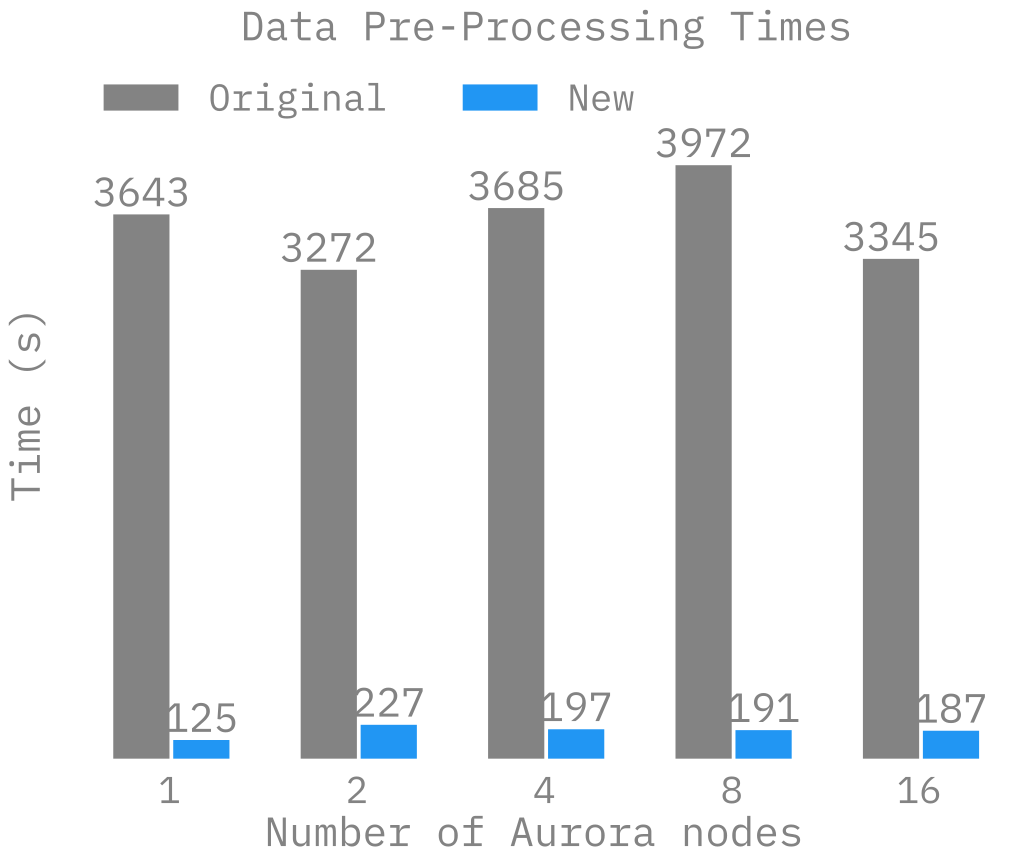
Before a single GPU does useful work, you have to curate, blend, and shard 2T+ tokens across many corpora (ArXiv, GitHub, Wikipedia, Reddit, StackExchange). This is a distributed-systems problem, and it has to be reproducible on every rank and every run, and survivable on a flaky filesystem with node failures and noisy neighbors. Three ordered steps: tokenize, blend, pin.
Tokenize once. Pin the tokenizer up front (we use SentencePiece), append an
end-of-document token per document, and emit fixed-size .bin shards plus a file
list the blender consumes. Document packing to the sequence length changes the
loss, so bake it into the shards, not the dataloader. The bottleneck here is the
filesystem, not the tokenizer: tokenization is I/O-bound, millions of small reads
plus a many-writer output that hammers shared Lustre. Read in large chunks, write
few large shards. Re-tokenizing 2T tokens is a whole-allocation tax, so you want
to pay it as rarely as possible.
Blend by weight, not by concatenation. A naive cat *.bin trains ArXiv for a
week and then Wikipedia for a day: order becomes a hyperparameter and the model
forgets. Instead, sample every batch to a fixed domain mixture, deterministically,
so the weights are honored per step. BlendCorpus does this as
aggregate → sample → index, and the index build is on the critical path for every
config change.
Pin everything. Same seed, same shards, same weights gives the same batch on
every rank, every run. Two things threaten that: data churn (re-scraped or
re-shuffled shards silently break determinism) and upstream churn (we track a
fork of torchtitan, and there were 46 upstream syncs in 7 weeks; any one can
shift the RNG). The defense is to pin exact repo SHAs, the tokenizer version, the
shard file lists, and the blend weights, all committed with the run. Every fork
sync runs a 50-step deterministic smoke test first, and “bit-exact” means loss,
gradient norm, and peak memory all match the baseline. This is not paranoia: an
upstream commit that “just refactored the dataloader” once changed the shuffle
order and quietly changed the loss curve.
A Python environment that survives Lustre
The second wall is mundane and brutal: one import torch fans out into thousands
of stat() and open() calls, and you are running it on 50,000 ranks at once. The
metadata server chokes long before bandwidth does. What is laptop-seconds becomes
cluster-minutes before step one, and you pay it every job. Per-file rsync past
256 nodes is projected at one to two hours, dominated by per-file metadata cost.
Python is pathologically small-file, and the fix is not a faster filesystem. It is
not hitting the filesystem from every rank.
Build the environment by layering on the site module rather than from scratch:
module load frameworks
uv venv --system-site-packages --python python3 .venv
source .venv/bin/activate
uv pip install "git+https://github.com/saforem2/ezpz"
The rule is venv first, clone last. --system-site-packages lets the venv see the
module’s prebuilt torch; skip it and you get a fresh CPU-only wheel.
Then broadcast that environment instead of rebuilding it everywhere. ezpz yeet
copies the env once to node-local /tmp and fans it out node-to-node, so imports
hit local SSD:
ezpz yeet --compress          # one tarball off Lustre
source /tmp/.venv/bin/activate
ezpz launch python3 -m your_app.train
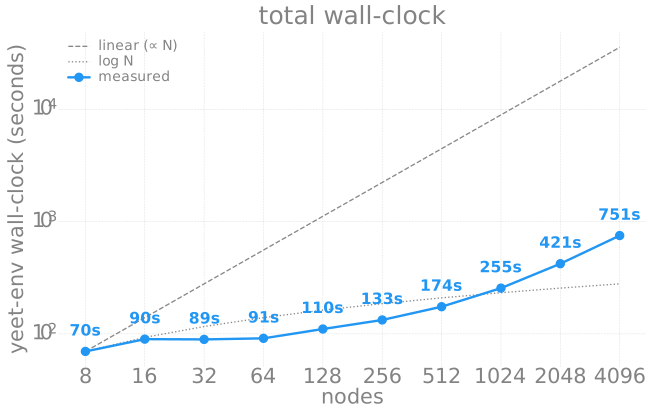
The trick is the fan-out. A single source saturates its NIC at roughly eight outbound copies, so each node that finishes becomes a new source and a thread pool routes each pending node to the least-busy source. That turns a star (O(N)) into a greedy tree (~O(log N)). Per-node cost drops from 8.7s to about 0.18s, a 48x improvement, and a full-Aurora pre-launch lands under 13 minutes.
The parallelism menu
Once a run starts, the question is how to split it. There are five axes, and you mix and match:
- DP (data parallel) splits the batch: every GPU holds a full model copy and processes different data. Reach for it first because it needs no model changes.
- FSDP / ZeRO is still data parallel, but shards the replicated optimizer, gradient, and parameter state and gathers it on demand. You buy memory with communication (an all-gather per step).
- TP (tensor parallel) splits individual weight matrices within a layer. It is chatty (an all-reduce inside every layer), so keep it on-node.
- PP (pipeline parallel) splits the model by layer into stages and streams micro-batches. It spans nodes fine but needs careful micro-batch scheduling.
- SP / CP splits the sequence dimension for long context, with ring-attention rotating the KV. EP splits the experts of an MoE layer.
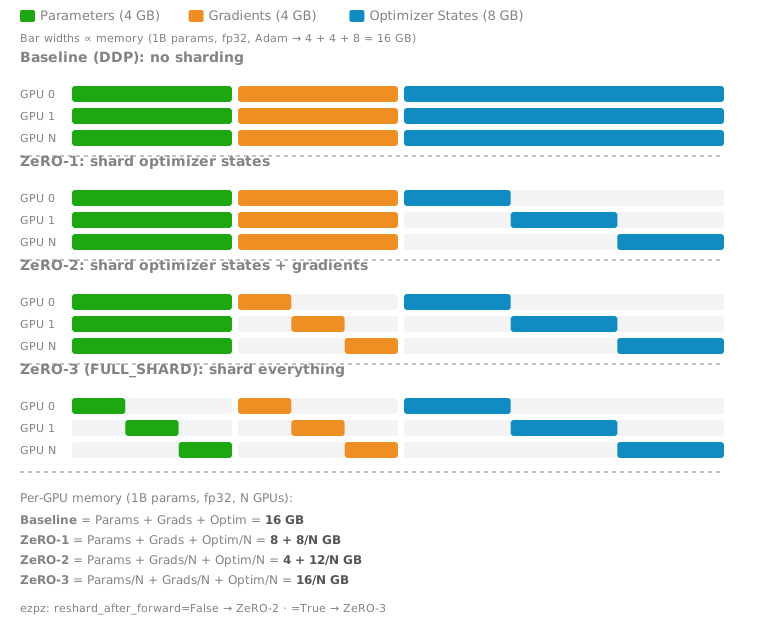
The heuristic that matters: climb only when memory forces you, in the order
DP → FSDP/ZeRO → TP → PP. If it fits on one GPU, use DP and scale the batch. If
it almost fits, FSDP/ZeRO (stage 1, then stage 3). If a single layer will not fit,
TP on-node and PP across. Add parallelism in order of pain.
Critical batch size
There is a tension between long-running pre-training and how HPC facilities allocate time. INCITE wants you on at least 20% of the machine, which on Aurora is around 2,000 nodes. More nodes with pure data parallelism means a larger global batch, and past a point a larger batch gives you a worse model and unstable training.
That point is the critical batch size, the largest batch where more data-parallel workers still buy near-linear speedup. Below it, doubling the batch roughly halves the steps and more nodes are nearly free. Above it, the speedup saturates and sample efficiency drops. HPC hits this ceiling first, precisely because the facility wants you wide.
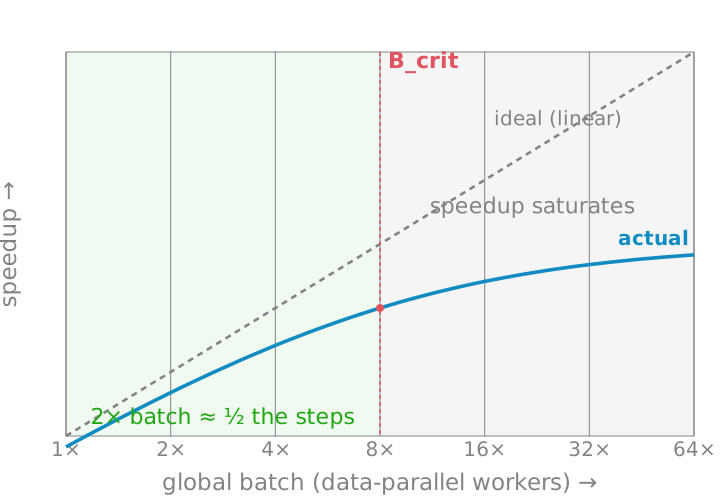
The fix is not “more DP.” It is TP/PP/EP plus a batch size you chose. The knobs
for going large are learning-rate scaling (linear or square-root), a longer
warmup, and gradient clipping, with a large-batch optimizer like LAMB. But
learning rates do not transfer for free: at 80B, a linearly-scaled LR moved the
NaN earlier (step 7 instead of step 29), and mano tuned at GBS=48 loses to
AdamW at GBS=384 (2.88 vs 2.71) unless you reparametrize with μP. Re-tune at the
target batch and node count. Do not extrapolate a small-batch LR up a 100x jump
and hope.
Optimizers, and the bf16 cliff
AdamW is the baseline. Everything else buys curvature at some compute price.
| Optimizer | Core idea |
|---|---|
| AdamW | diagonal 2nd moment + decoupled weight decay |
| SophiaG | clipped Hessian-diagonal: light curvature, cheap |
| Shampoo | Kronecker-factored preconditioner per layer |
| SOAP | Adam in Shampoo’s eigenbasis: stabler, fewer knobs |
| Muon | Newton-Schulz orthogonalize: a cheap Shampoo-like step |
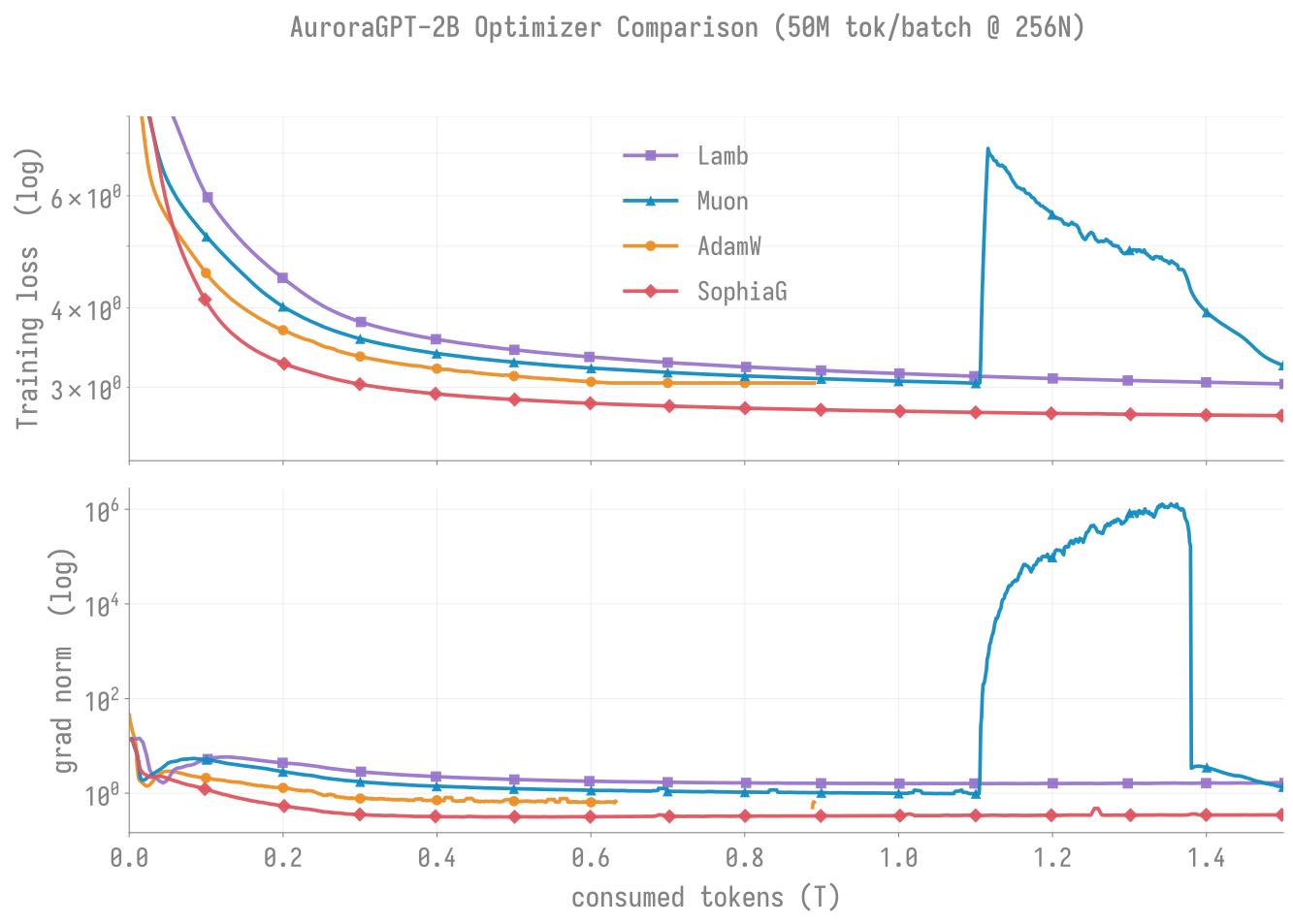
Shampoo → SOAP → Muon is one family with the same second-moment structure, getting cheaper each step. SophiaG takes the other cheap route, a clipped diagonal Hessian. For the 2B reference run we chose SophiaG because at GBS=6,144 it was the only optimizer that reached a low loss while keeping gradient norms bounded. Muon, by contrast, diverges around 1.1T tokens with a gradient-norm spike of roughly six orders of magnitude.
A newer entry, mano, normalizes updates on a rotating Oblique manifold using
O(dim) vector-norm operations and no Newton-Schulz iterations, so it matches
Muon’s loss without Muon’s throughput tax. At 2B over 1000 steps, Muon and mano
tie on loss around 3.6, but mano runs at AdamW speed (~7,048 vs ~4,556 TPS), so
it wins on wall-clock. The caveat from the previous section applies: at GBS=384,
AdamW still wins on loss, because mano’s LR was tuned at GBS=48.
The most instructive failure was at 80B. With a dim of 9216, every
constant-learning-rate finder NaN-ed in the first dozen steps. The signature was
always the same: the gradient norm went to infinity one step before the loss did,
while the loss still looked flat around 12.9.
| Optimizer | Died at | Signature |
|---|---|---|
mano | step 5 | grad NaN (diverged first) |
| AdamW | step 9 | grad NaN |
| SophiaG | step 14 | Hessian-term overflow (~6,100 node-hours) |
Two things stand out. First, mano died first despite having the safest-looking
80B learning-rate band, which means early-step ranking does not predict sustained
stability. Second, three different optimizers failing the same way points to a
corner-level instability (bf16 at dim=9216), not a tuning problem. The stable
corner today is TP=4, LBS=1, GBS=372, validated 100 out of 100 steps NaN-free
(loss 12.93 → 7.72) at about 9.8% MFU, with a fix in flight built on a longer
warmup (≥200 steps), gradient clipping, and possibly an fp32 gradient path.
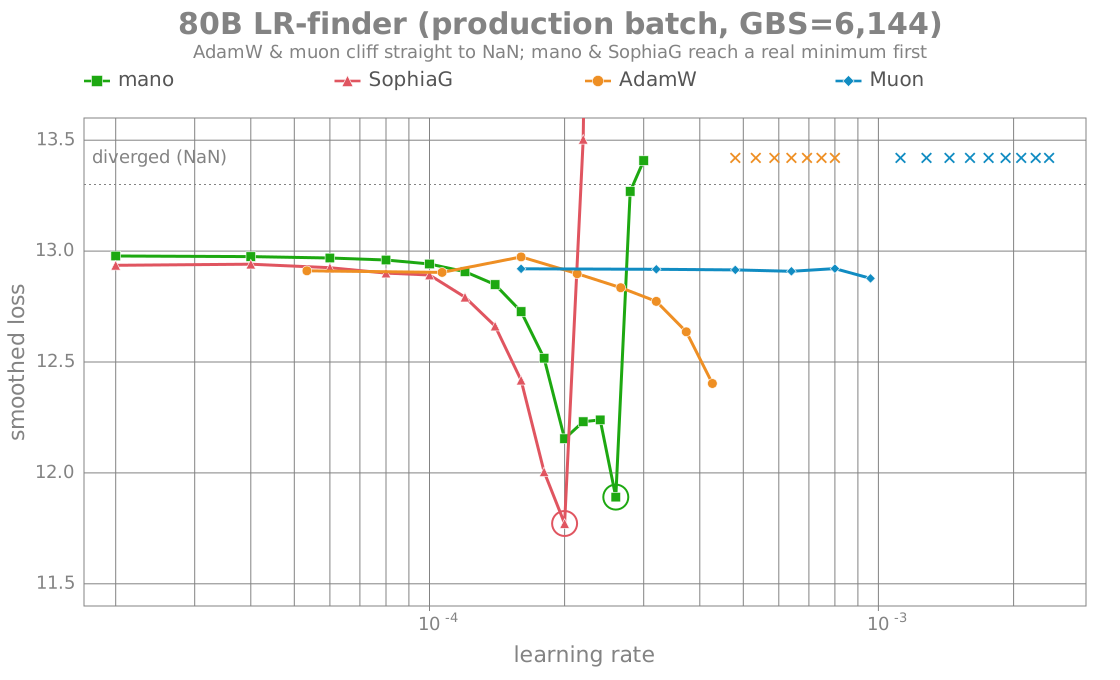
The way to find a learning rate at all is the classic sweep: ramp the LR exponentially over the first ~10% of training, watch the loss, and pick just below the point where it turns up. There are three regions: a flat high plateau, a basin, and a cliff where one step too big sends the gradients to infinity and the run NaNs. A few hundred steps to sweep saves a full-scale run that dies at step 7.
At scale, failure is the default
The arithmetic is unforgiving. Cluster mean-time-between-failures is roughly single-node MTBF divided by N. If a node fails about once a year and you put 16,000 of them in one job, that is around 44 failures a day, from expected value alone. Everyone who has run at this scale reports the same thing: Llama 3 405B saw 419 interruptions over 54 days (about one every three hours, 99% auto-recovered); OPT-175B needed 35 manual restarts and cycled 100+ hosts; BLOOM and GLM-130B fought frequent loss spikes. You do not plan for the happy path. You plan for the failure.
The operational cost is not the failures themselves. It is telling transient faults (retry and you are fine) from systemic ones (retry just reproduces the problem). Retry a systemic fault and you burn your spare pool; halt on a transient one and you waste walltime you already paid for.
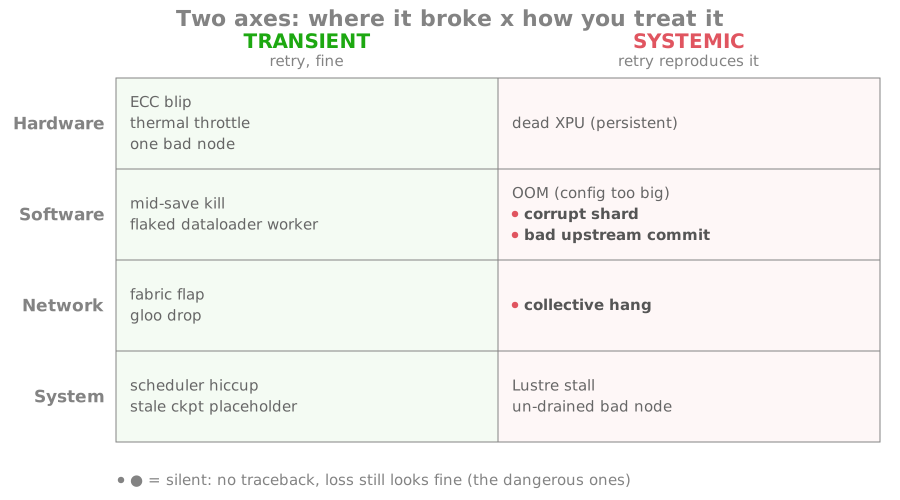
The silent failures are the worst, because the loss keeps looking reasonable while the model learns nothing or logs the wrong number. Two real ones from production:
- A bf16 master copy froze RMSNorm. The loss looked fine, but lm-eval never moved (ARC-Easy stuck at the random baseline for 17,000+ steps). RMSNorm weights initialize at 1.0, where the bf16 unit-in-last-place is about 7.8e-3, but the per-step update was about 1.6e-5, so every update rounded to zero. All 25 RMSNorm tensors sat at exactly 1.0. Linear layers were fine because their smaller init put the update and the ULP in the same range. The fix was an fp32 master with a mixed-precision policy (bf16 compute, fp32 reduce), costing about 10 GB extra at 20B. The lesson: loss looks like training, but lm-eval is the only ground truth.
- Tensor parallelism reported the loss 1/12 too low. Step-1 loss for a 256K
vocab should be about
ln(256128) ≈ 12.45. TP=1 showed 12.95, but TP=2 after an upstream commit reported 1.07, which is exactly 12.84 divided by thedp_world_sizeof 12. A distributed reduction short-circuited on the wrong mesh and silently dropped the cross-batch sum. Gradients and optimizer steps were correct; only the logged number was wrong. Filed astorchtitan#3204.
The other flavor of silent failure is the network. At full-machine scale the
interconnect is never fully healthy. The loud version is a gloo “Connection
closed by peer” a few hours in, and at least it gives you an exit code. The quiet
version is a collective that just stops: every rank blocks in the same
all_reduce, the process is alive by kill -0, and on XPU xccl silently
ignores train_timeout_seconds, so the hang consumes the entire PBS walltime. One
20B/512N job hung at step 803 with its heartbeat still ticking. The one signal you
can trust is that a hang quiets stdout. Absence of progress is the detector.
Checkpointing without melting the cluster
A checkpoint is your only insurance policy: when the job dies, you resume from the
last one and everything since is wasted work. At 20B a checkpoint is 232 GB
(weights, optimizer state at roughly 2x the model, plus scheduler, step, RNG, and
dataloader position). A synchronous save stalls training about 23.6s and a reload
is 55-63s, dominated by dcp.load.
The Lustre tax you paid on reads comes back on the write path, now with every rank flushing 232 GB to the same metadata server. Worse, a checkpoint write that contends with training collectives on the same fabric can take the whole job down.
The answer is asynchronous checkpointing done carefully: snapshot to host memory on the training thread (fast), then stage and flush on a background thread while the GPUs keep going, and bound how many ranks flush at once.
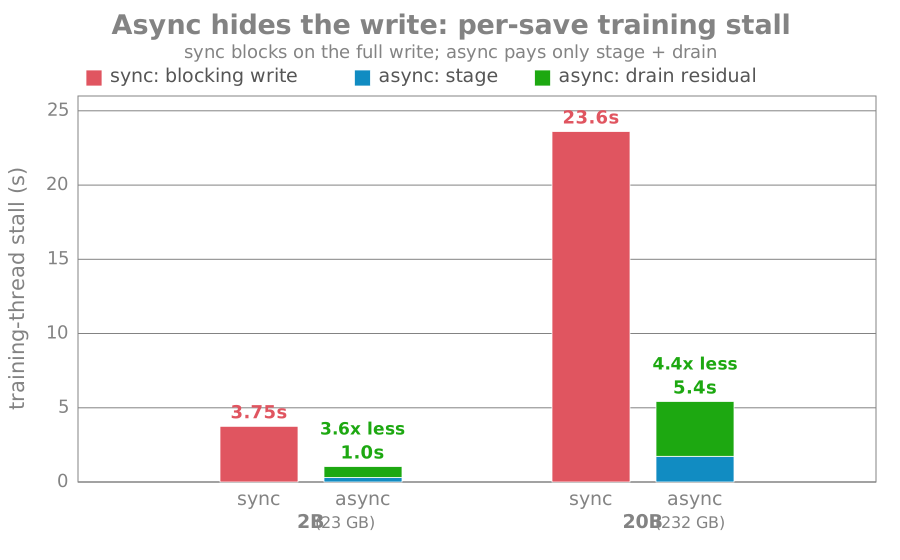
Done wrong, it is a foot-gun. At 20B/512N and beyond, an unbounded async save
contends with training collectives and takes the whole job down. And there is a
failure that hides inside checkpointing itself: a PBS mid-save kill once left a
stale step-4500/ placeholder directory, the sync path assumed the save was
complete, and the run sat walltime-blocked for weeks. A half-written checkpoint is
worse than no checkpoint, which is why the discipline is a bounded fan-out plus a
.complete marker written last, so an incomplete checkpoint is skipped on reload.
Restarting quickly matters as much as saving. The recovery clock runs from crash
to first-step-back-training, not from crash to “file exists.” So stage the
checkpoint node-local (the same ezpz yeet fan-out, rather than 512 ranks pulling
232 GB off Lustre at once), and keep converters between formats
(Megatron ⇄ HF ⇄ ZeRO ⇄ Universal) so you can resume at a different TP/PP/DP than
you saved at, and evaluate or serve from the HF export.
Fault-tolerant training
Recovery is layered, because different failures live at different timescales:
- JOB scope (PBS, hours): crash or walltime triggers a chained resubmit.
- NODE scope (failover wrapper, minutes): a bad host is detected and swapped from a spare pool.
- PROCESS scope (
ezpz launch, seconds): stdout goes idle, so kill and back off.
Inner loops catch most failures; outer loops catch the rest. The node layer moved
out of bash and into ezpz:
# 522 nodes allocated; train on 512, 10 auto-reserved as spare.
ezpz launch --auto-retry --nhosts 512 \
  -- python -m torchtitan.train …
--auto-retry classifies each attempt’s exit as success, walltime, bad-node, or
stuck-pre-training. On a bad node it scrapes the failing host from the log, swaps
in a spare, and re-execs. It guards against config bugs by stopping after two
consecutive attempts with zero step= markers, so a broken run does not burn the
whole spare pool. It broke the 20B/512N stall mentioned above, driving that run
from step 4,400 to 5,400 cleanly, and it ships in
ezpz#144.
The process layer is the watchdog that catches silent hangs. Since a hang quiets
stdout, --timeout SECONDS kills the launched process if its output goes idle
(not on walltime) and returns exit code 124 to match GNU timeout(1), and
--retries N re-execs on any non-zero exit with exponential backoff. Under
--auto-retry the watchdog is on by default, matching FAILOVER_IDLE_TIMEOUT. It
fires on absence of progress, not a heartbeat ping, because a hung job is “alive”
by kill -0.
All of it fired unattended, in sequence, on a real silent hang. Job 8505298 on a
Friday night logged step 37, then went silent; 30 minutes later the
--timeout=1800 watchdog sent SIGTERM, the wrapper classified exit 124 as a
silent hang (distinct from a PBS walltime exit 143), found no traceback to scrape
so blindly swapped the rank-0 host, and relaunched on a fresh node set, which ran
to walltime with checkpoints persisted. Nobody was awake for any of it.
The whole thing composes into one launch:
ezpz yeet --compress
source /tmp/.venv/bin/activate
ezpz launch \
    --auto-retry \    # NODE: swap bad hosts from the spare pool
    --nhosts 512 \    #       (allocate 522, keep 10 spare)
    --timeout 1800 \  # PROCESS: kill on 30 min stdout silence
    --retries 3 \     #          re-exec with exponential backoff
    -- python3 -m torchtitan.train --config-file ./config.toml
# JOB layer: a chained PBS resubmit wraps the whole thing (hours scope)
Where production stands
The payoff is a program of runs, not a single hero number. The 2B reference, trained on the older Megatron-DeepSpeed stack, completed one continuous 7.77T-token run across three data-mix stages, ending at loss 2.03. The torchtitan chains and the 20B runs advance under auto-retry.
| Run | Nodes | Steps | Tokens | Loss | Status |
|---|---|---|---|---|---|
| 2B base | 256 | 92,859 | 4.674T (100%) | 2.65 | ✅ complete |
| 2B-MDS reference | 256 | 154,391 | 7.770T | 2.03 | ✅ 3-stage reference |
| 20B/512N | 512 | 6,010 | 605B (13%) | 2.44 | advancing (auto-retry) |
| 20B/256N | 256 | 6,301 | 159B (3%) | 2.44 | advancing |
| 80B | 512 | 14 | (NaN’d) | NaN | ❌ optimizer cliff |
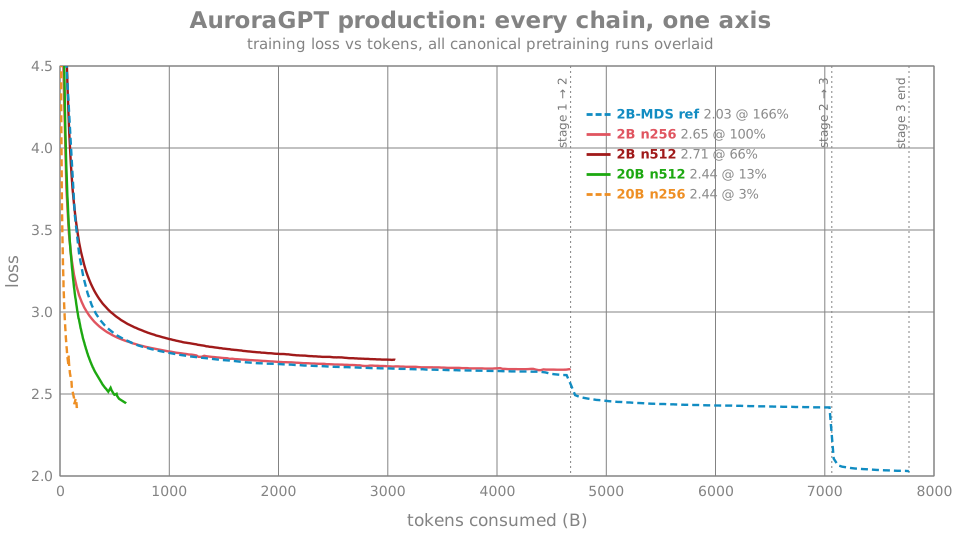
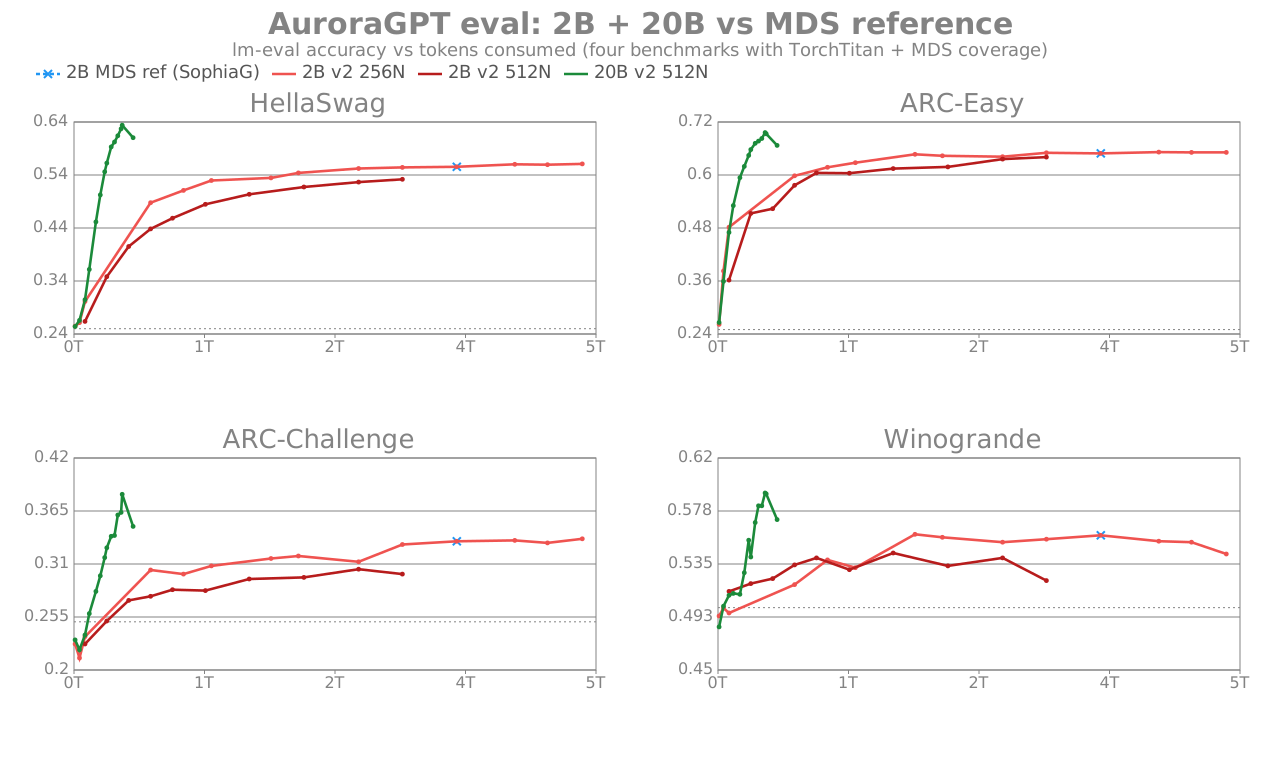
The reason the 20B runs matter, despite being early in their token budget, is token efficiency. On every benchmark the 20B/512N chain rises far steeper per token than either 2B chain, reaching ARC-Easy around 0.69 and HellaSwag around 0.63 by roughly 440B tokens, beating the 2B chains at matched token counts by close to 8x. That is “more model per GPU-hour” made literal.
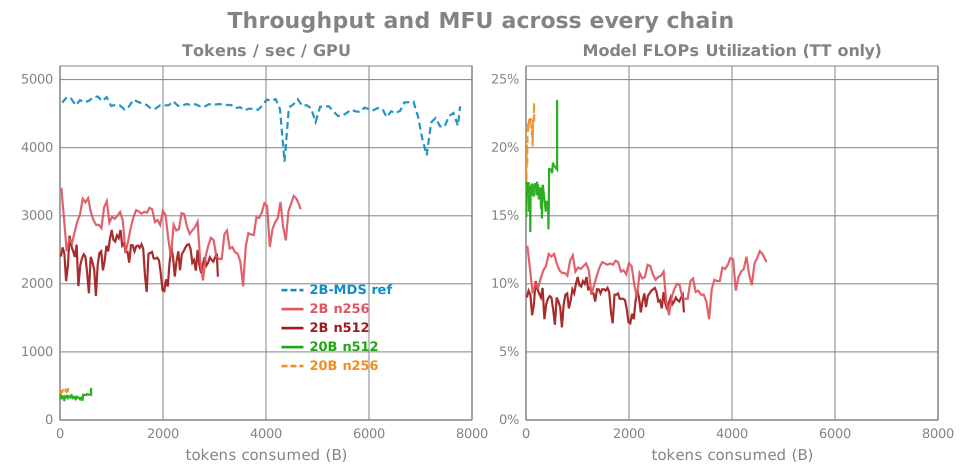
The throughput picture explains why. Bigger models get fewer tokens/sec/GPU but higher model FLOP utilization, because the larger matmuls keep the XPUs busier: the 20B chains sit around 17-22% MFU versus 9-12% for 2B.
What generalizes
Some of this transfers to any vendor and any machine, and some of it has to be re-earned every time.
Generalizes. A bit-exact deterministic smoke gate after every upstream sync. lm-eval as the ground truth for whether the model is actually learning, since the loss will lie to you. A spare-node failover wrapper (the same idea works on Slurm). Launcher and environment autodetection, so vendor assumptions never leak into the training code.
Does not. torch.compile decisions (it helps dense models and can hurt MoE on
XPU). Activation-checkpointing boundaries. The EP-versus-FSDP frontier. Collective
tuning across XCCL, gloo, and the NCCL/CCL environment. And optimizer stability at
the bf16 corner, where, as the 80B cliff showed, the learning-rate-finder ranking
does not predict sustained stability.
If there are five things to take home:
- Data prep is a distributed-systems problem. Tokenize once, blend by weight, pin everything.
- Do not hit Lustre from every rank. Stage node-local and broadcast the environment.
- Add parallelism in order of pain (
DP → FSDP/ZeRO → TP → PP) and stay under the critical batch size. - Loss is not ground truth. Gate on evals, and let a bit-exact smoke test catch silent corruption.
- Do not try to prevent failures. Recover cheaply, with async checkpoints and layered auto-restart.
The full decks, with speaker notes and the rest of the figures, are at TPC’26, the MoE Workshop, and ATPESC 2026.
This research used resources of the Argonne Leadership Computing Facility, a U.S. Department of Energy Office of Science user facility, under Contract DE-AC02-06CH11357.